Career Resources
Reach self-understanding, career exploration, applications, interviews and transition support.
Open resourcePrimary youth transition pathway
Connect people. Evidence. Support. Opportunity. Better human decisions.
PAVRA is SCP’s human-governed Youth Transition pathway for bringing the young person, relevant support, evidence and opportunity-provider readiness together before consequential decisions and action.
It is developmental rather than pass/fail and does not automate matching or placement. Human judgement, safeguarding and accountable review remain explicit.
Non-clinical · Human-governed · Evidence-aware · No automated placement · Safeguarding-led partner delivery
How PAVRA connects the Youth Transition system
PAVRA does not simply signpost a young person to an opportunity.
It brings together the young person, relevant support, available evidence, opportunity-provider readiness and accountable human review so that better-informed decisions can be made at the right time.
The pathway is developmental rather than pass/fail: a decision may lead to access, access with support or adjustments, further readiness development, referral or redesign, additional information, or a pause before review.
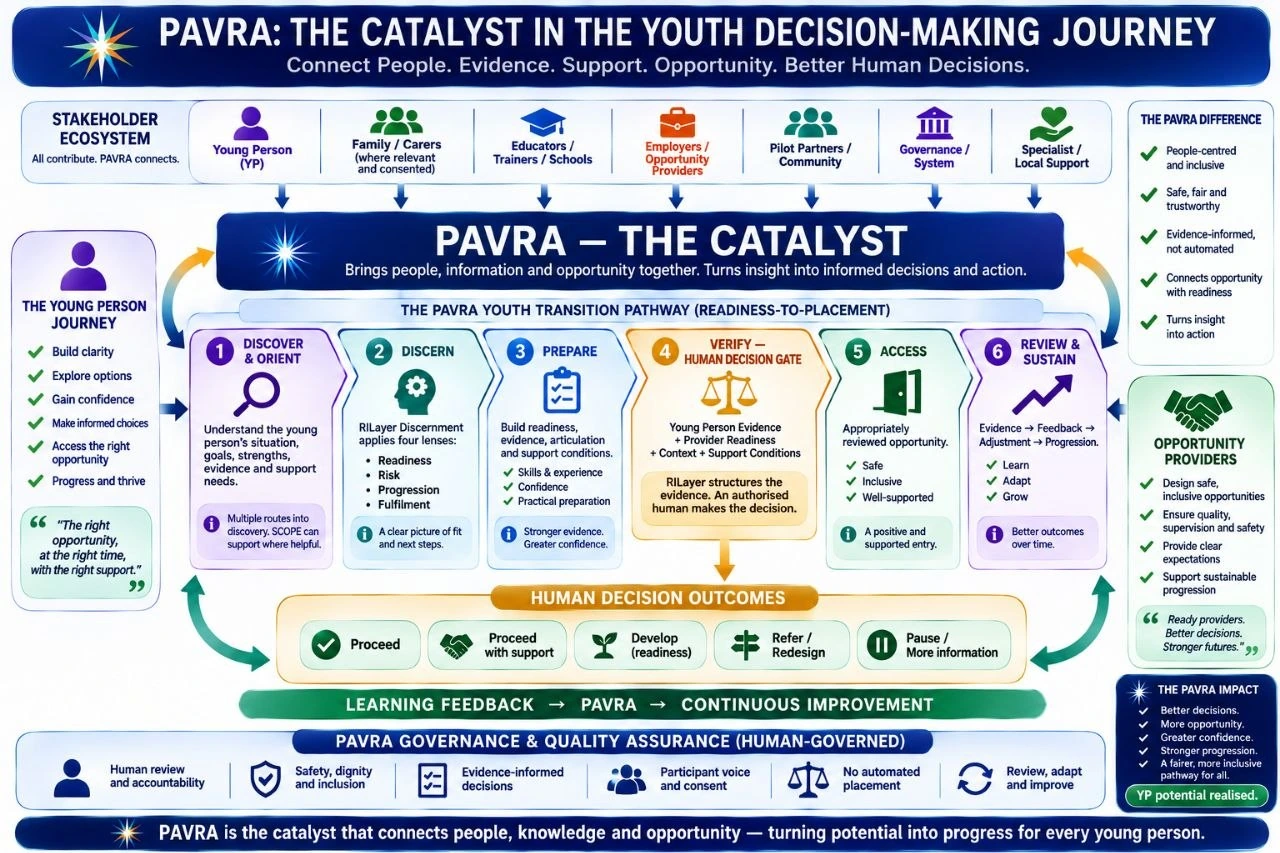
Understand the young person’s situation, goals, strengths, evidence and support needs. Discovery can happen through self-reflection, an adviser, mentor, SCOPE or another appropriate support route.
Use the four RILayer Discernment lenses — Readiness, Risk, Progression and Fulfilment — to clarify fit, uncertainty and the next governed step.
Build readiness evidence, articulation, practical preparation and the support conditions needed for a better-informed decision.
Bring young-person evidence, opportunity-provider readiness, context and support conditions into authorised human review. RILayer structures evidence; an accountable human decides.
Move into an appropriately reviewed opportunity where the decision supports access, with agreed support or adjustments made explicit.
Use evidence, feedback and review to learn, adapt and support sustainable progression over time.
Human Decision Gate
An authorised human chooses the route justified by the evidence, context, support conditions and operating boundary.
First flagship validation focus
The West Midlands is PAVRA’s immediate priority geography for partner engagement and real-world validation discussions.
SCP Ltd is currently seeking appropriate regional partners to explore whether a bounded PAVRA Youth Transition pilot should be developed and, if so, what its scope, participants, governance requirements and success measures should be.
The purpose is not to introduce another youth jobs platform. It is to test, with prospective partners, whether human-governed readiness-to-placement infrastructure could improve decisions around young-person readiness, opportunity-provider readiness, support, evidence, access and sustainable progression.
Why PAVRA exists
Many young people have ability, ambition and informal skills but lack structure, language, trusted evidence and a safe route towards the right opportunities.
PAVRA helps make the transition visible: where the young person is now, what they can explain, what they can demonstrate, what still needs support and which next steps are realistic.
Supporting conditions
Placement, Articulation, Verification, Readiness and Access remain useful supporting conditions inside the Catalyst journey. They are not a second competing pathway and they do not reduce readiness to a single score.
Understand the young person’s present position, transition stage, support environment, barriers and responsible starting conditions.
Help the young person explain strengths, interests, values, learning, experience, aspirations and support needs clearly.
Turn reflection, participation, practical activity and feedback into reviewable evidence of what is established or emerging.
Develop the behaviours, capabilities, judgement, confidence and responsibility needed for a sustainable next step.
Support movement towards suitable learning, mentoring, volunteering, work insight, enterprise, training or employment pathways without promising outcomes that cannot be guaranteed.
Five development capability areas
These five areas describe capabilities that can be practised, evidenced, reviewed and strengthened. They are distinct from RILayer’s four Discernment lenses: Readiness, Risk, Progression and Fulfilment.
Self-awareness, agency, focus, learning habits, goal-setting and responsibility for practical next steps.
Communication, listening, teamwork, professional behaviour, help-seeking and trusted support relationships.
Interpreting information, comparing options, solving problems, learning from feedback and making context-aware decisions.
Initiative, contribution, service, project participation, enterprise thinking and responsible influence.
Digital confidence, online professionalism, information judgement, ethical AI use and safe evidence-building.
What young people can build
The aim is not to manufacture a perfect profile. It is to help the young person explain what they have learned, what they can demonstrate and what should happen next.
Multiple routes into discovery
Discovery may begin through self-reflection, a career adviser, mentor, family or carer support where relevant and consented, an education or community setting, SCOPE, or another appropriate trusted route.
The important point is not which tool is used first. It is whether the young person reaches the next decision with sufficient authorised evidence, clarity, support and accountable human involvement.
Understand optional SCOPE supportConnected, not competing
PAVRA coordinates existing SCP strengths rather than turning every framework, resource or heritage strand into a separate public pathway.
Early curiosity, confidence and career imagination before structured transition work begins.
The HumanRI formation journey across Discovery, Discernment, Development, Dedication and Integration.
The career-information and articulation map: Find Yourself, Opportunities, Communication, Use Information and Starting.
A governed discernment framework that helps clarify the starting point without diagnosis or psychological assessment.
An optional structured reflective workspace for organising questions, evidence, assumptions, options and risks. It is not a mandatory gateway into PAVRA discovery.
The organisation-facing infrastructure for readiness, governance, implementation evidence and accountable human review.
The safety, dignity, evidence, privacy, boundaries and human-oversight layer across the pathway.
Choose your route
The public page provides orientation. Structured delivery, evidence capture and opportunity access require appropriate human, partner and governance arrangements.
Start with where you are, understand what you are developing and prepare for a responsible next step without being expected to have everything figured out.
Move from worry or pressure towards a clearer way of supporting reflection, development, evidence and realistic transition planning.
Explore how PAVRA can complement career education, employability, mentoring, enrichment and transition support through governed partner delivery.
Support mentoring, work insight, project briefs, digital access, evidence-building and responsible routes into opportunity.
Safeguarding, boundaries and trust
PAVRA is a non-clinical youth development and transition-readiness pathway. It does not replace safeguarding procedures, pastoral systems, emergency support, therapy, medical care, legal advice or statutory services.
Age-appropriate tasks, supervision, data protection, role boundaries and human escalation routes must be established before structured delivery or partner-supported opportunity begins.
From pathway to validation
The immediate partner-development focus is the West Midlands. The next step is dialogue and validation, not a claim that a pilot has already been secured.
PAVRA resource network
PAVRA should not operate as an isolated pathway. These resources support young people to understand themselves, articulate capability, prepare evidence and move toward opportunity without losing agency.
Reach self-understanding, career exploration, applications, interviews and transition support.
Open resourceTranslate strengths and experience into clearer CV, application and professional evidence.
Open resourceUse structured prompts for self-awareness, readiness and evidence conversations.
Open resourceSearch retained employability, communication, job-search and transition resources.
Open resource