


Most organisations are not failing because people lack skill, effort, or commitment.
They are failing because performance systems assume a level of internal reflective capability that many people are never supported in building.
The result is familiar:
- Strong talent that plateaus
- Engagement initiatives that spike, then fade
- Wellbeing support that arrives too late
- Performance that depends on pressure rather than sustainability
This isn’t a motivation problem.
It’s a capability gap.
And the missing link is reflective capability.
Organisations rarely design the capability
For decades, workforce development has focused on the visible layers of performance:
- Skills and competencies
- Processes and frameworks
- Targets, metrics, and outputs
More recently, organisations have added:
- Wellbeing programmes
- Mental health awareness
- Engagement surveys and pulse checks
These efforts matter.
But they often operate around people, not within them.
What’s missing is the internal capability that allows individuals to:
- Use skills effectively under pressure
- Apply wellbeing tools when it actually matters
- Learn from experience rather than repeat patterns
- Adapt behaviour in complex, ambiguous situations
That capability is reflective capability.
What reflective capability actually is (and isn’t)
Reflective capability is not therapy.
It is not introspection for its own sake.
And it is not a “soft” add-on.
Reflective capability is the human meta-capacity to:
- Regulate attention, emotion, and energy
- Recognise patterns in behaviour and decision-making
- Pause before reacting under pressure
- Choose actions aligned with values, priorities, and goals
In short:
Reflective capability is what allows people to think clearly, act intentionally, and recover effectively — at work.
It is the engine beneath performance, motivation, and well-being.
Why performance initiatives so often plateau
Many organisations follow a predictable cycle:
- Introduce a new performance, engagement, or well-being initiative
- See early enthusiasm
- Watch uptake decline
- Add something else
This isn’t because employees don’t care.
It’s because most interventions assume people already have the internal capacity to self-apply them.
Under real workplace pressure:
- Reflection collapses
- Self-regulation weakens
- Habits dominate
- Decision quality deteriorates
Without reflective capability, even the best-designed systems struggle to stick.
What is MaxME Solutions?
MaxME Solutions exists to address this exact gap.
MaxME is a human-centred capability development ecosystem designed to strengthen reflective capability so that performance, motivation, and well-being become sustainable rather than extractive.
Instead of adding more initiatives, MaxME focuses on what enables people to benefit from what already exists.
It integrates:
- Reflective coaching models
- Meta-skills development
- Clear behavioural pathways
- Ethical, human-led use of technology
With firm boundaries:
- Not therapy
- Not diagnosis
- Not a replacement for human judgment
The guiding principle is simple:
Sustainable performance is built internally, not enforced externally.
The simplified MaxME framework (how it works)
The MaxME approach can be understood as a capability system, anchored by reflection.
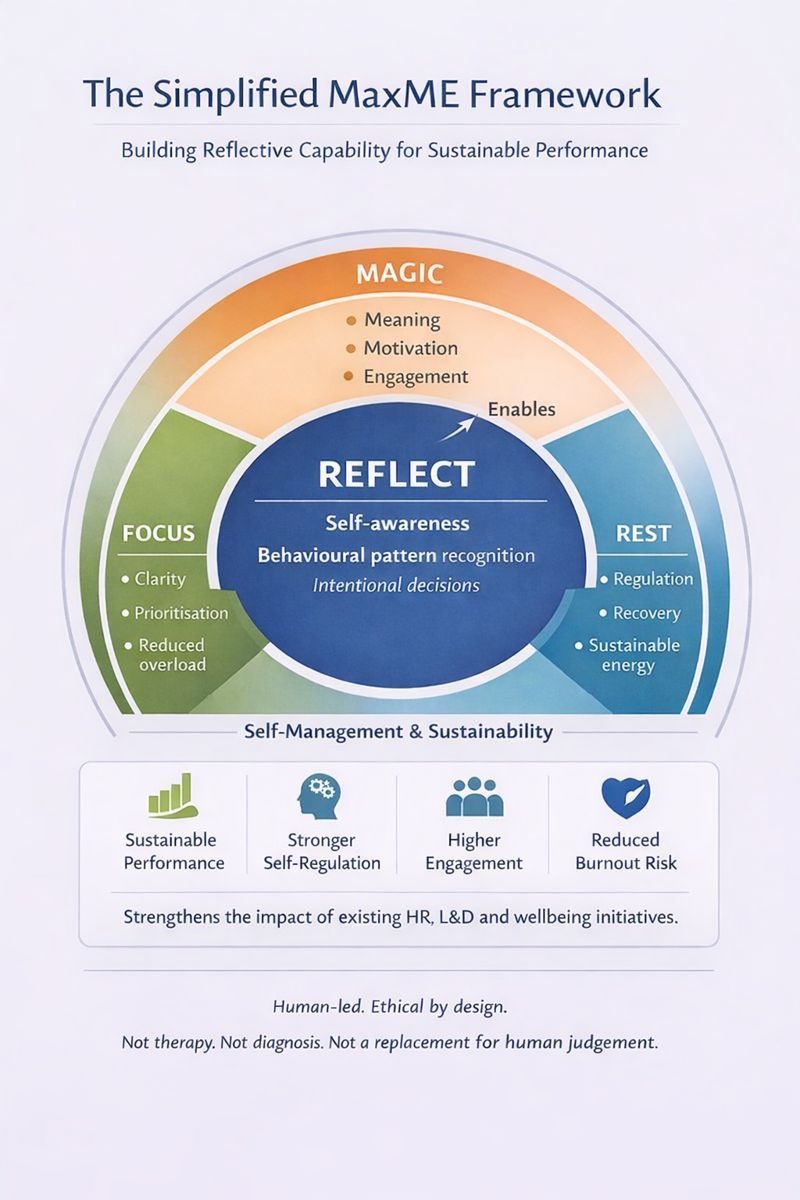
Core capability
REFLECT
- Awareness of patterns
- Learning from experience
- Intentional decision-making
This is the anchor. Without it, other interventions remain fragile.
Self-management & sustainability
FOCUS
- Attention and clarity
- Cognitive prioritisation
- Reduced overload
REST
- Regulation and recovery
- Burnout prevention
- Sustainable energy
Motivation & engagement
MAGIC
- Meaning and identity
- Intrinsic motivation
- Ownership and commitment
What organisations experience
- Improved self-regulation
- Better decision quality
- Sustainable performance
- Higher engagement
- Lower burnout risk
All delivered through human-led coaching, supported (where appropriate) by ethical, transparent technology.
Why this matters now
Work is faster, more complex, and less predictable than ever.
People are expected to:
- Self-manage ambiguity
- Adapt continuously
- Perform emotionally as well as cognitively
Yet most systems still operate on an unspoken assumption:
“If we give people the right tools, they’ll figure it out.”
Reflective capability is what allows them to do exactly that.
Organisations that invest here are not just supporting wellbeing — they are future-proofing performance.
A different conversation about development
MaxME Solutions does not replace HR, L&D, or well-being strategies.
It strengthens the human capability that allows those strategies to work.
It helps organisations:
- Develop people who perform without burning out
- Support motivation without manipulation
- Build capability without dependency
And it does so with:
- Ethical clarity
- Human-in-the-loop design
- Respect for professional and organisational boundaries
Final thought
Performance rarely fails because people don’t care.
It fails when people are asked to operate beyond their internal capacity for too long.
Reflective capability is not a “nice to have”.
It is the missing link.
And when it is deliberately developed, everything else starts to work better.
📩 Curious about reflective capability in your organisation?
I’m always open to thoughtful conversations about sustainable performance, capability development, and reflective growth — for individuals, teams, and organisations.
