

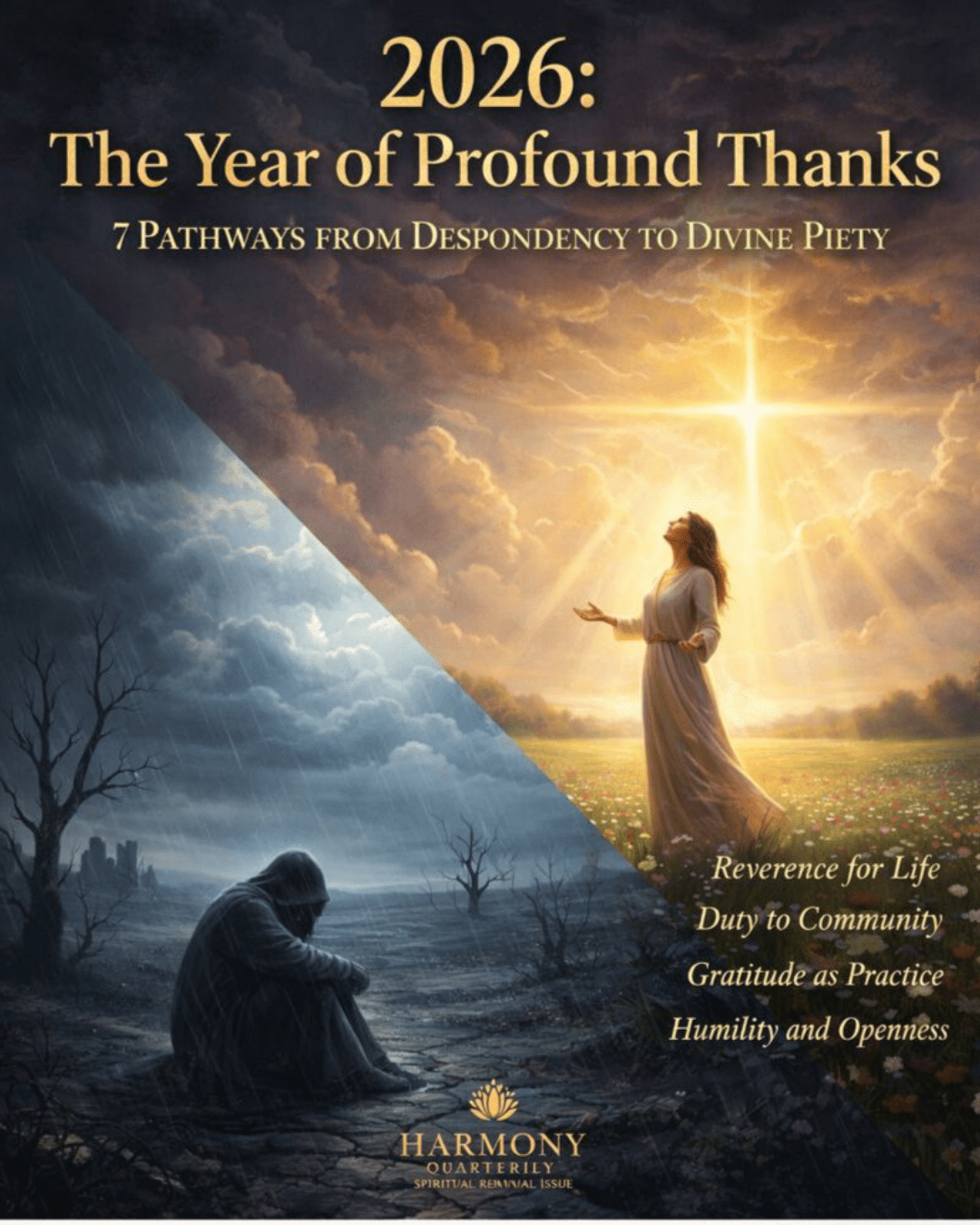
7 Pathways from Despondency to Divine Piety
The Year of Profound Thanks does not emerge from comfort or excess. It rises from the ashes of fatigue, loss, uncertainty, and quiet grief that have marked recent years. As humanity steps into 2026, we do not arrive untouched. We arrive carrying the weight of collective disruption—health crises, economic instability, social fragmentation, and persistent conflict that have not merely shaken systems, but deeply strained the human spirit.
What many feel now is not panic, but something quieter and more corrosive: despondency. A slow erosion of hope. A resignation that healing may never fully come.
And yet, history, faith, and conscience whisper a different truth.
Naming 2026 as The Year of Profound Thanks is not denial—it is defiance. Gratitude, rightly understood, is not a reaction to ease. It is a moral, spiritual, and communal discipline forged in difficulty.
Understanding the Weight of Despondency
Despondency does not announce itself loudly. It settles silently.
It shows up as disengagement, cynicism, emotional withdrawal, and the creeping belief that one’s effort, presence, or faith no longer matters. In an age saturated with information yet starved of meaning, despondency thrives.
Across cultures and belief systems, the same question echoes:
What is the point of hoping anymore?
From a Christian lens, despondency mirrors the wilderness seasons of Scripture—moments where reassurance is stripped away and faith must either deepen or dissolve. Yet this experience is universal. Every spiritual tradition names it: the dark night of the soul, existential fatigue, the testing of purpose.
The Year of Profound Thanks does not ignore this terrain. It walks directly into it.
Reclaiming the True Meaning of Piety
Few words have suffered as much distortion as piety.
Reduced to hollow ritual, moral superiority, or performative religiosity, piety has been pushed to the margins of modern conversation. But at its core, piety is not about appearance—it is about orientation.
Piety is a life rightly aligned.
- Reverence without fear
- Duty without resentment
- Devotion expressed through responsibility
For Christians, piety flows from love of God and neighbour—agape made visible through humility, prayer, and service. Across faiths and philosophies, it carries the same essence: life is sacred, interconnected, and accountable beyond the self.
In a time of despondency, piety is not retreat.
It is resistance.
The Seven Pathways of Profound Thanks
In The Year of Profound Thanks, gratitude is not merely felt—it is practised. These seven pathways offer disciplines capable of restoring meaning where exhaustion has taken root.
1. Reverence for Life
To live with piety is to refuse the numbing of wonder. Reverence restores our capacity to see life—fragile, flawed, fleeting—as worthy of care and protection. Where despair dulls the senses, reverence awakens responsibility.
2. Duty to Community
True piety never isolates. Across spiritual traditions, devotion is expressed through justice, compassion, and care for the vulnerable. The Year of Profound Thanks reminds us: no one thrives alone, and no one heals in isolation.
3. Gratitude as a Daily Practice
Gratitude is not naïveté—it is courage. It names what is broken without surrendering to bitterness. In practising gratitude, we acknowledge grace not because circumstances are easy, but because life itself remains a gift.
4. Humility and Openness
Piety tempers certainty with humility. It recognises human limitation and invites wisdom beyond ego. In a fractured world, humility may be one of the most radical spiritual acts available to us.
5. Faithful Perseverance
Moving from despondency to piety requires endurance. Not dramatic heroics, but quiet faithfulness—showing up again, praying again, serving again, even when results feel invisible.
6. Moral Responsibility
The Year of Profound Thanks calls us to accountability. Gratitude without responsibility becomes sentiment. True piety expresses itself through ethical living, integrity, and care for the common good.
7. Hope Rooted in Action
Hope is not wishful thinking. It is disciplined action aligned with meaning. In 2026, hope must take form—in compassion, justice, reconciliation, and service.
A Year That Demands a Response
To declare 2026 as The Year of Profound Thanks is to issue a summons.
Not too optimistic.
Not to deny.
But to alignment.
For the Christian heart, this year calls for faith beyond performance—gratitude expressed through embodied love, sacrifice, and service. For the interfaith soul, it offers shared moral ground. Whether one speaks of God, Allah, Brahman, the Great Spirit, or the Source of Life, the call is the same: reverence, gratitude, and responsibility toward one another.
Choosing the Higher Ground in 2026
The journey from despondency to divine piety is not automatic. It is chosen—daily and deliberately.
It looks like:
- Mindful reflection in a distracted world
- Active compassion in an age of fatigue
- Spiritual attentiveness amid constant noise
- Communal solidarity where isolation has become normal
This is not the easier path.
But it is the truer one.
Final Reflection: Why the Year of Profound Thanks Matters
In this Year of Profound Thanks, may we resist the slow pull of despair. May we recover piety not as a relic, but as a remedy. And may we remember—even in our darkest hours—that gratitude is not born from comfort, but from the courage to recognise the sacred still at work in a wounded world.
2026 does not ask us to pretend everything is well.
It asks us to live as if meaning still matters.
And it does.
Loading approved comments…