

Living abroad can be one of life’s most enriching experiences. It can open doors to new cultures, relationships, opportunities and ways of seeing the world.
It can also unsettle parts of life that once felt familiar.
For expatriates, accompanying partners and globally mobile professionals, relocation is rarely just a practical move from one country to another. It can become a deeper transition involving identity, confidence, belonging, purpose and connection.
Familiar routines may change.
Professional momentum may feel interrupted.
Social networks may need to be rebuilt from the beginning.
A person who felt confident in one environment may suddenly feel uncertain in another.
In that space, even capable and resilient people can find themselves asking:
Who am I in this new place?
Where do I fit?
How do I rebuild confidence, connection and direction?
What does growth look like for me now?
These questions are not signs of weakness. They are often signs that a person is paying attention to the deeper human impact of transition.
Relocation changes more than our surroundings. It can change how we see ourselves, how we relate to others and how we make sense of what matters next.
Relocation is practical — but it is also deeply personal
When people talk about moving abroad, the focus is often practical: housing, schools, visas, healthcare, employment, language, transport and local systems.
These things matter. They create stability.
But beneath the practical transition is often a quieter emotional and reflective journey.
For accompanying partners, relocation may involve moving in support of a loved one’s career while quietly trying to rediscover personal direction. It may involve a paused career, a changed professional identity, reduced access to familiar support systems, or a sense of being underutilised or unseen.
For globally mobile professionals, the challenge may look different but still be deeply personal. You may still have a role, title or organisational structure, yet internally you may be adjusting to unfamiliar expectations, cultural norms, communication styles and social codes.
You may be outwardly functioning while inwardly trying to understand where you belong.
That is why personal growth abroad is not simply about doing more. Sometimes, it begins with pausing long enough to understand what has changed within you.
Before we can confidently connect outward, we often need to reconnect inward.
Why connection matters when living abroad
Connection is more than meeting people.
It is the experience of feeling seen, heard, understood and rooted somewhere.
For expatriates and accompanying partners, meaningful connections can support confidence, well-being, cultural integration and professional growth. It can also help transform relocation from something you simply manage into something you grow through.
Yet connection in a new country often requires courage.
It may mean introducing yourself repeatedly.
It may mean learning new cultural cues.
It may mean participating before you feel fully settled.
It may mean rebuilding confidence one conversation at a time.
This is where reflection and structure become important.
Reflection gives language to what we are experiencing.
Clarity helps us identify what we need.
Small, intentional actions help us rebuild confidence and belonging over time.
The FOCUS Method for personal growth abroad
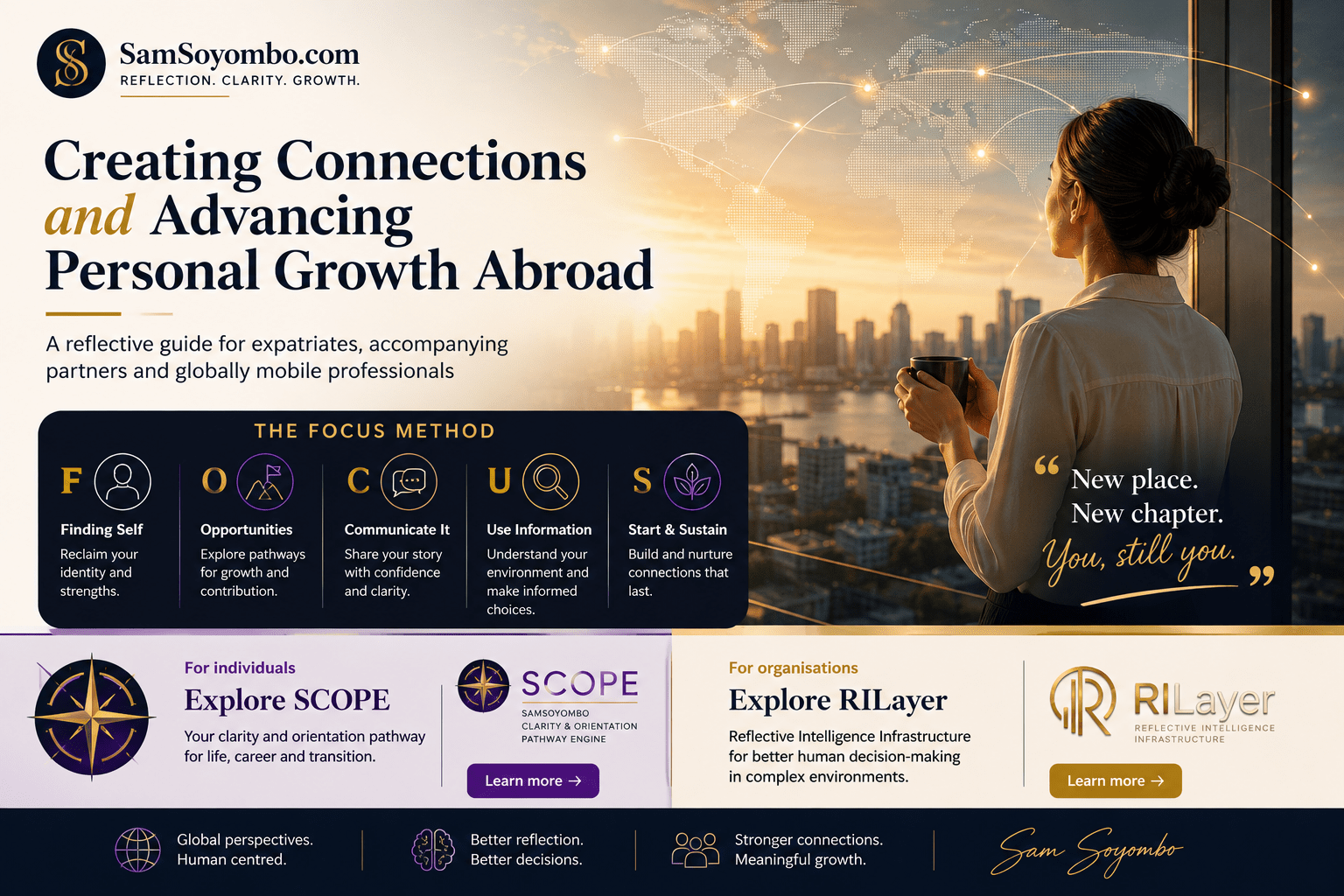
The FOCUS Method is a reflective framework I use to help individuals think more clearly during periods of transition, uncertainty and personal change.
It is especially relevant for expatriates, accompanying partners and globally mobile professionals because relocation often disrupts more than routine. It can interrupt confidence, belonging, purpose, direction and decision-making.
FOCUS stands for:
F — Finding Self
O — Opportunities
C — Communicate It
U — Use Information
S — Start & Sustain
The framework is not about forcing yourself to have everything figured out. It is about creating enough space to understand where you are, what matters now and what small step could help you move forward.
F — Finding Self
Core insight: Relocation can blur your sense of identity.
When familiar routines, roles and relationships change, it is easy to feel as though parts of yourself have become quieter or less visible. You may still be the same person, but the environment that once reflected your strengths, contributions, confidence, or status may no longer be readily available.
Finding Self is about reconnecting with who you are beyond your current circumstances.
Pause and ask:
What strengths, values and experiences have travelled with me?
What parts of myself do I want to recognise again?
What gives me a sense of meaning, energy or contribution?
What have I learned about myself since relocating?
This step matters because connection with others often begins with connection to yourself.
O — Opportunities
Core insight: A new environment may feel limiting at first, but it can also open unexpected pathways.
Relocation can interrupt familiar plans. It can also create space for learning, volunteering, mentoring, community involvement, networking, career exploration and personal growth.
Opportunities do not always appear immediately. Sometimes they emerge through curiosity, conversation and small acts of participation.
Pause and ask:
What could I explore locally?
What skills, interests or experiences could I use in this new context?
Where might I contribute, learn or connect without needing everything to be perfect first?
What possibilities have I not yet allowed myself to consider?
This step helps shift attention from what has been interrupted to what may still be possible.
C — Communicate It
Core insight: Confidence grows when we can express who we are and what we are looking for.
For many people living abroad, this can be challenging. You may be introducing yourself in a new language, culture or professional environment. You may be unsure how to describe your background, your transition, your current season or your future aspirations.
You may also feel caught between different identities: who you were before relocation, who others see you as now and who you are becoming.
Communicate It is about learning to tell your story with clarity and confidence.
Pause and ask:
How do I introduce myself in this season of transition?
What part of my story do I want others to understand?
What do I need to communicate more confidently in social, cultural or professional spaces?
How can I speak about my experience without minimising myself?
This step is not about performing confidence. It is about finding language for your experience.
U — Use Information
Core insight: Information reduces uncertainty and helps confidence grow.
Every culture has visible and invisible rules. Understanding local expectations, systems, opportunities and social norms can help you make more informed choices.
Information may include practical knowledge, such as where to find services, groups, learning opportunities or employment support. It may also include cultural understanding: how people build trust, how networks form, how opportunities are shared and how communication styles may differ.
Without information, uncertainty can easily become self-doubt. With the right information, you can begin to see your environment more clearly and act with greater confidence.
Pause and ask:
What information would help me feel less uncertain?
Who or what could help me understand this environment better?
What assumptions might I need to test or update?
Where can I find reliable guidance, community insight or practical support?
This step reminds us that confidence often grows when uncertainty becomes clearer.
S — Start & Sustain
Core insight: Connection is built through small, consistent actions.
Starting may mean attending a community event, arranging one conversation, joining a local group, updating your professional profile, volunteering, reconnecting with an old interest, or taking one step towards a personal goal.
Sustaining means returning to those actions with patience and care.
Pause and ask:
What is one small action I can take this week?
What relationship, routine or opportunity do I want to nurture?
How can I make connection part of my rhythm, not just a one-off effort?
What support do I need to keep going when confidence dips?
The goal is not simply to meet more people. The goal is to build meaningful networks that support belonging, confidence and growth over time.
Growth begins with better questions
Progress rarely begins with a perfect plan. More often, it begins with a better question.
What do I need in this season of transition?
What parts of me have been quiet for too long?
Where do I want to feel more connected?
What strengths am I ready to use again?
What small step could help me feel more grounded this week?
These are not abstract questions. They are practical entry points for anyone trying to rebuild confidence, belonging and momentum in a new environment.
Good questions do not solve everything immediately, but they help us stop drifting. They give us a place to begin.
From relocation to reflective growth
Relocation can unsettle identity, but it can also deepen it.
It can reveal strengths we had forgotten.
It can expose needs we had ignored.
It can invite us to build new forms of courage, confidence and connection.
The aim is not to pretend that relocation is always easy. It is not. There may be loneliness, frustration, uncertainty and moments of self-doubt.
But with the right reflection, support and structure, relocation can become more than an adjustment process. It can become a growth process.
This is where reflective development matters.
When individuals have space to pause, name what is happening, understand what matters and take the next meaningful step, they are better able to move from confusion to clarity, from isolation to connection and from transition to growth.
For individuals: continue your reflection through SCOPE
If this article resonates with where you are, you may find it helpful to continue the reflection through SCOPE.
SCOPE — the SamSoyombo Clarity & Orientation Pathway Engine — is designed to help individuals organise their thinking, clarify their situation and identify meaningful next steps.
It is especially useful when you are navigating transition, uncertainty, career questions, confidence issues, personal direction or decision pressure.
SCOPE does not make decisions for you. It helps you reflect more clearly so you can understand what you are facing and decide what step may be appropriate next.
Use SCOPE when you want to:
- make sense of a transition;
- clarify a career or life direction question;
- organise your thoughts before taking action;
- reflect on confidence, purpose or belonging;
- turn uncertainty into a more structured next step.
Continue your reflection: Explore SCOPE
For organisations: explore RILayer
For organisations, relocation, transition and human performance are not only personal issues. They are also decision, judgment, and support issues.
Employees, expatriates, managers and teams often operate under uncertainty, pressure and complexity. In those moments, the quality of human judgement matters.
RILayer is a Reflective Intelligence Infrastructure designed to support better human decision-making in complex environments.
It is not coaching, training or a simple AI tool. It is an infrastructure layer that helps organisations create more structured, reflective and accountable decision environments.
RILayer is relevant for organisations that want to strengthen:
- decision quality;
- reflective practice;
- human judgement under pressure;
- transition support;
- leadership clarity;
- workforce adaptability;
- governance around AI-assisted decision-making.
Where SCOPE supports individuals with clarity and orientation, RILayer supports organisations with reflective intelligence infrastructure.
For organisations and partners: Explore RILayer
A gentle next step
Whether you are newly relocated, several years into an international journey, or supporting others through transition, it is never too late to reconnect with what matters.
You do not need to have everything figured out. You do not need a perfect plan.
Sometimes the most powerful next step is simply to pause, recognise what is changing and choose one small action that helps you move forward with more clarity.
Living abroad changes us.
With reflection, connection and the right support, it can also grow us.
That is the heart of the FOCUS Method — and a useful starting point for anyone seeking greater clarity, confidence and connection abroad.
Loading approved comments…